


The first-ever Funko POP! figure was Batman from the 1966 TV series, modeled after Adam West's portrayal. This figure debuted at the 2010 San Diego Comic-Con as part of the initial lineup of four DC Comics characters, which also included a metallic Batman variant, Batgirl, and Green Lantern. Originally called "Funko Force 2.0", the figures were later rebranded as "Funko POP!" in 2011.
This Batman figure set the standard for the now-iconic design: a 3.75-inch vinyl figure with an oversized head, simple black eyes, and detailed features. It was sold for around $10 and has since become a collector's item, valued between $100 and $150 in mint condition.
The introduction of the POP! line marked a major shift for all Funko products, transitioning from bobbleheads to static vinyl figures. Despite initial skepticism from traditional collectors, the new design attracted a broader audience, helping Funko achieve massive success. By 2025, Funko had sold over 1 billion POP! figures worldwide.
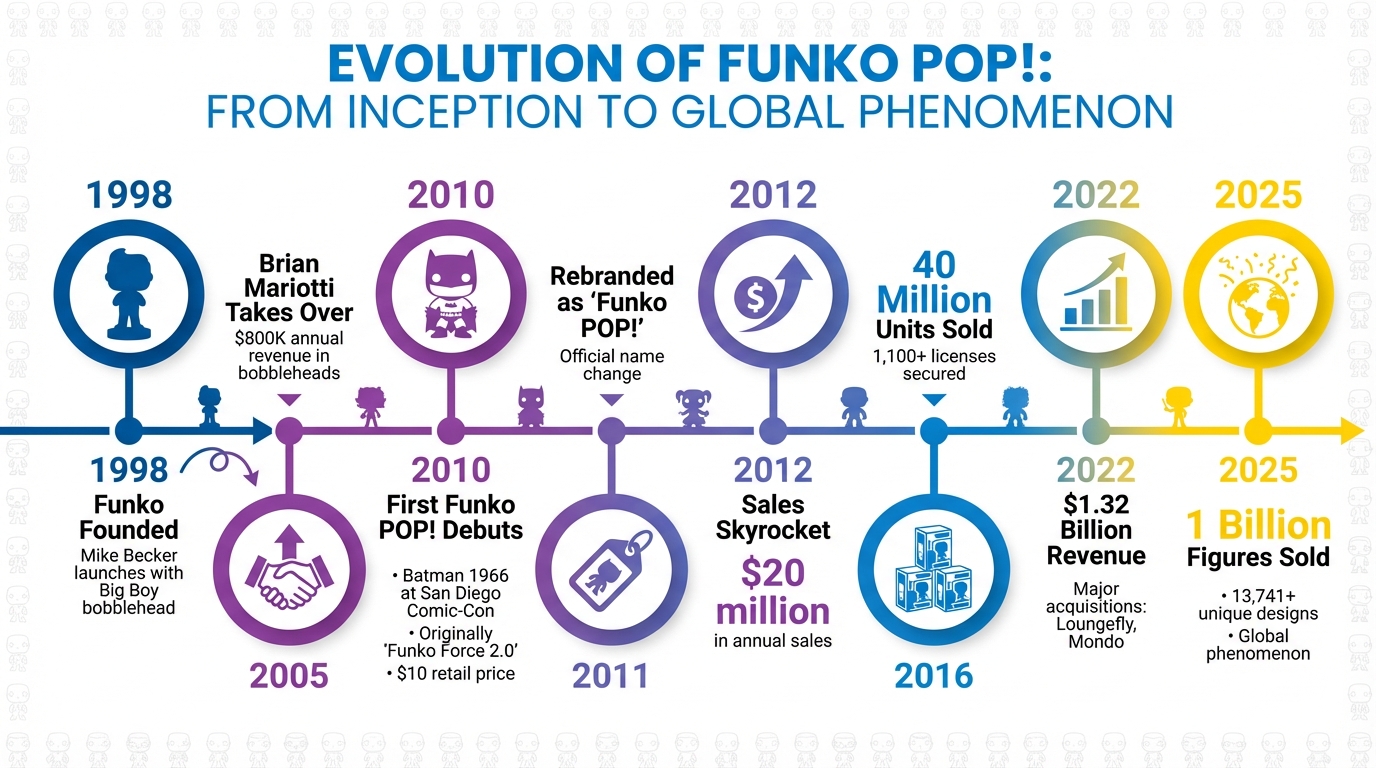
Funko POP! History Timeline: From First Figure to 1 Billion Sales
The Early Days of Funko and the Launch of the POP! Line
From Wacky Wobblers to POP! Vinyl Figures
Funko's story began in 1998 when Mike Becker founded the company and introduced its first product: a bobblehead of the Big Boy restaurant mascot. Known as "Wacky Wobblers", these figures featured slim bodies with spring-mounted heads that gave them a playful bounce. The designs focused on nostalgic characters rather than tapping into current pop culture trends. This early era preceded the introduction of modern mascots like Eddy Funko.
The company's trajectory shifted dramatically in 2005 when Brian Mariotti took over Funko. Under his leadership, Funko saw a spike in sales, reaching $800,000 annually in bobblehead revenue within a year. However, Mariotti had bigger plans. He began experimenting with new product lines, like "Fantastik Plastik", which introduced static vinyl figures without the signature bobblehead movement. These experiments marked a departure from Funko's original style and laid the foundation for what would eventually become the POP! line.
Mariotti took a creative gamble with the concept of a unified, stylized design that could bring together characters from a wide range of franchises - think DC Comics, Marvel, and Star Wars. The bold design, with its squared-off heads and oversized black eyes, gave the figures a distinct look, making them easily recognizable as part of one cohesive collection. This daring move set the stage for a pivotal moment in Funko's history: the debut of the POP! line at Comic-Con.
The 2010 San Diego Comic-Con Launch
In 2010, Mariotti introduced the new figures - originally called "Funko Force 2.0" - at San Diego Comic-Con. The lineup featured just four DC Comics characters: Batman (in his 1960s style), a metallic Batman variant, Batgirl, and Green Lantern.
Recalling the event, Brian Mariotti shared:
"I brought them to Comic-Con in 2010, and got a horrible response from our diehard bobblehead fans. But we were getting all these unique people in our booth - mainly women - that had never been in there before. And I knew at that point we had a hit on our hands." - Brian Mariotti, CEO, Funko
This shift in audience was a game-changer. While traditional collectors dismissed the static design, a new group of customers, many of whom had never engaged with Funko before, were drawn to the cute and stylized aesthetic. By 2011, the line was rebranded as "Funko Pop!" and quickly gained traction.
The numbers tell the story: by 2012, just two years after its launch, Funko's annual sales had skyrocketed to over $20 million. By 2016, the company had sold an astonishing 40 million POP! figures, proving that Mariotti's vision was spot on. This marked the beginning of a new era for Funko, setting the stage for the creation of the very first Funko POP! figure and the legacy that followed.
sbb-itb-9b27a27
What Was the First Funko POP! Made?
Batman 1966: The First Funko POP!
The very first Funko POP! figure was Batman from the 1966 TV series. When Funko introduced its initial lineup of four DC Comics characters at San Diego Comic-Con in 2010, this specific Batman - modeled after Adam West's portrayal - was given the honor of being number one in the Pop! Heroes line. Alongside this classic Batman, the lineup included a Metallic Batman variant, Batgirl, and Green Lantern.
The choice of the 1966 Batman wasn’t random. The series' campy and playful vibe perfectly aligned with Funko's goal of creating "hip and fun" collectibles. The bright, pop-art aesthetic of the show translated seamlessly into the exaggerated, oversized-head design that would become the hallmark of the POP! line. This release didn’t just introduce a figure - it laid the groundwork for an entire design philosophy.
Design and Features of the First Funko POP!
The original Batman figure set the standard for what would become the signature Funko POP! style. Measuring 3.75 inches tall, it featured an oversized squared-off head with large, simple black eyes, all crafted from durable vinyl. The costume details stayed true to Adam West's portrayal, showcasing gray spandex, blue gauntlets, and the unmistakable yellow utility belt.
Initially sold in plastic clamshell packaging for around $10, this figure has since become a collector's item, often valued between $100.00 and $150.00 in mint condition. Its clean, consistent design not only captured the essence of the character but also established a versatile template. This template allowed Funko to expand the POP! line to include characters from virtually any franchise, paving the way for its massive success.
The Growth of Funko POP! After the First Release
Early Licensing and Expansion
After debuting at the 2010 San Diego Comic-Con, Funko quickly broadened its scope beyond DC Comics. Under the leadership of CEO Brian Mariotti, the company secured licensing agreements across a wide array of entertainment sectors, including films, TV shows, comic books, and video games. Funko also implemented a fast production cycle, capable of turning ideas into retail products in just 70 days.
One of their early hits, the Austin Powers bobblehead line, sold an impressive 80,000 units, showcasing their ability to create appealing licensed merchandise. This success helped Funko establish partnerships with major players like Disney, Warner Bros., NBCUniversal, Paramount Global, and Sony. By the mid-2010s, Funko had amassed over 1,100 licenses, covering everything from Marvel and Star Wars to music legends and sports icons.
Brian Mariotti (former CEO/CCO) emphasized that Funko's "eagerness to gain so many licenses and have a range of products from music icons and video game characters to action heroes is what has made them succeed."
This aggressive licensing strategy laid the groundwork for Funko's expansion into mainstream retail markets.
From Niche Collectible to Global Brand
With its growing list of licenses, Funko shifted from niche collectible status to a household name. The 2012 launch of the Game of Thrones line was a pivotal moment, broadening its appeal beyond specialty collectors. Soon, Funko POP! figures were available at major retailers like Walmart and Target, attracting millions of casual buyers.
The company continued to evolve by diversifying its product lineup and expanding its reach. Acquisitions like Loungefly (fashion accessories) and Underground Toys (European distribution) in 2017, followed by Mondo (high-end collectibles) in 2022, further strengthened its portfolio. Funko also opened flagship stores in Everett, Washington, and Hollywood, alongside international locations in Dubai. These locations often host exclusive events featuring Freddy Funko collectibles that celebrate the brand's heritage. These moves reflected the same innovative energy that had driven their early success. By September 2025, Funko had sold an astonishing 1 billion POP! Vinyl figures worldwide and reported $1.32 billion in revenue for 2022.
The History Of Funko Pops (2010 - 2020)
Conclusion
The 2010 Batman figure set a new standard for pop culture collectibles, becoming the blueprint for the now-iconic Funko POP! design. Since its debut, this design has been adapted into over 13,741 figures spanning nearly every entertainment franchise imaginable.
This bold move from traditional bobbleheads to the distinct POP! style was a game-changer for Funko. What started as a gamble turned into a worldwide phenomenon, with the company selling over one billion units to date. Back in 2010, Funko had to actively seek out licensing deals, but today, licensors are eager to see their characters transformed into Funko figures. This shift not only revolutionized Funko’s business model but also set a new benchmark for collectible design.
The success of Funko POP! figures also reshaped the perception of collectibles. They proved that items could be both affordable and highly sought-after. The standardized design made it possible to scale production quickly while maintaining quality across thousands of characters. By 2014, just four years after the launch, Funko had already sold 40 million units.
Collectors today enjoy a thriving market thanks to the foundation laid by this initial figure. Limited releases and convention exclusives have created a vibrant secondary market where rare items can fetch impressive prices. For instance, the 2013 SDCC Freddy Funko as Jaime Lannister, limited to only 12 pieces, is valued between $20,000 and $40,000.
For those looking to expand their collections or hunt down rare pieces, understanding this history adds depth to the experience. Retailers like Product Sage Collectibles provide access to exclusive and hard-to-find figures, complete with premium packaging and free protectors to help preserve your collection for years to come.
FAQs
How can I tell if a Batman 1966 POP! is the 2010 SDCC original?
To spot the 2010 SDCC original Batman 1966 POP!, look for its inclusion in the Funko Force 2.0 line and its distinctive dome-style packaging. This collectible debuted at SDCC 2010 and was capped at just 480 pieces. Check the packaging design, serial number, and edition size - if these align, you probably have the original release.
Why was the POP! line renamed from Funko Force 2.0 in 2011?
In 2011, the POP! line underwent a name change from Funko Force 2.0 to better emphasize its focus on collectible vinyl figures. This rebranding played a key role in giving the product line a clearer identity and aligning it more effectively with the brand's overall vision.
What affects the resale value of the first Batman POP!?
The resale value of the first Batman Funko POP! hinges on a mix of factors. Rarity is a big one since it's the very first in the Funko POP! series. Condition also matters - mint or unopened pieces tend to fetch higher prices. Exclusivity can boost value too, especially if it’s a limited edition or tied to a specific event. Beyond these, the figure’s historical importance and Batman’s enduring popularity significantly influence its demand and market price.

